Start a conversation

Mobility intelligence

The French car market, measured from the dealership visit

18 brands and 2,829 dealerships, over 92 days and under one single qualified visit. No anchor brand and no surveys: only the physical visit that already happened.

Read the report

Read it in full online, no sign-up. To take the PDF with you we ask for your email.

The seven cuts

Seven questions that get settled in a budget meeting, not a marketing one: who gets the visit, with what network, from which public and from where.

01

A single group captures more than a quarter of the visits

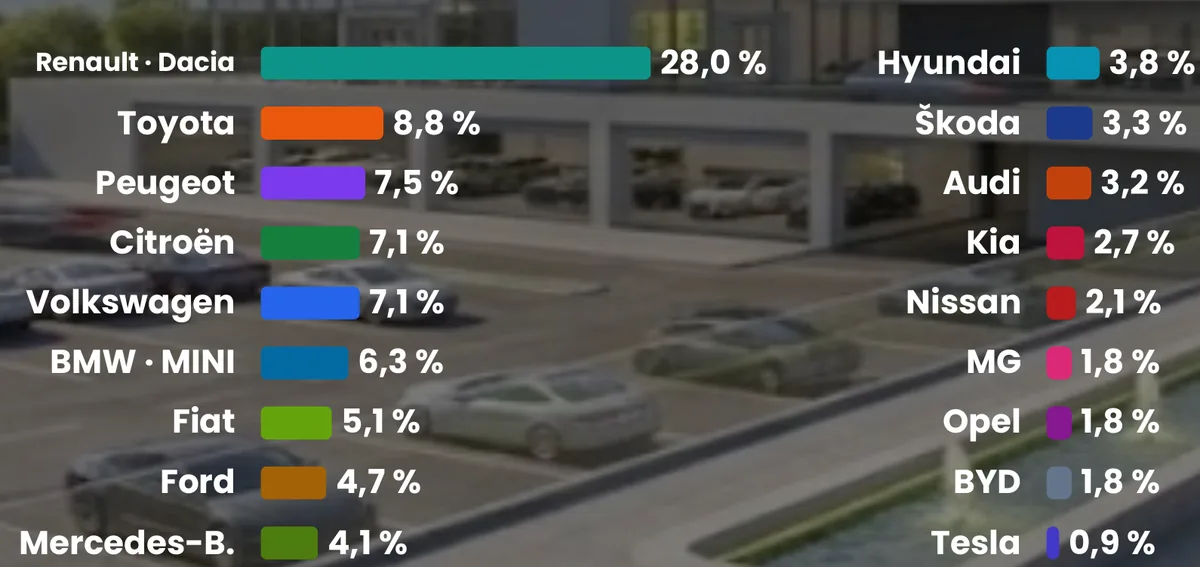
Renault and Dacia, measured together, capture 28.0 % of dealership visits and sit far ahead of the rest of the market. Toyota comes second, a long way behind (8.8 %). Peugeot (7.5 %), Citroën (7.1 %) and Volkswagen (7.1 %) form a tight pack. Among the premium brands, the BMW · MINI pair (6.3 %) takes the lead over Mercedes-Benz (4.1 %) and Audi (3.2 %). The second half of the ranking remains highly fragmented: MG, Opel and BYD share modest slices, 1.8 % each, and Tesla brings up the rear (0.9 %). This is dealership traffic, not sales.
02

Traffic often rests on a few flagship dealerships

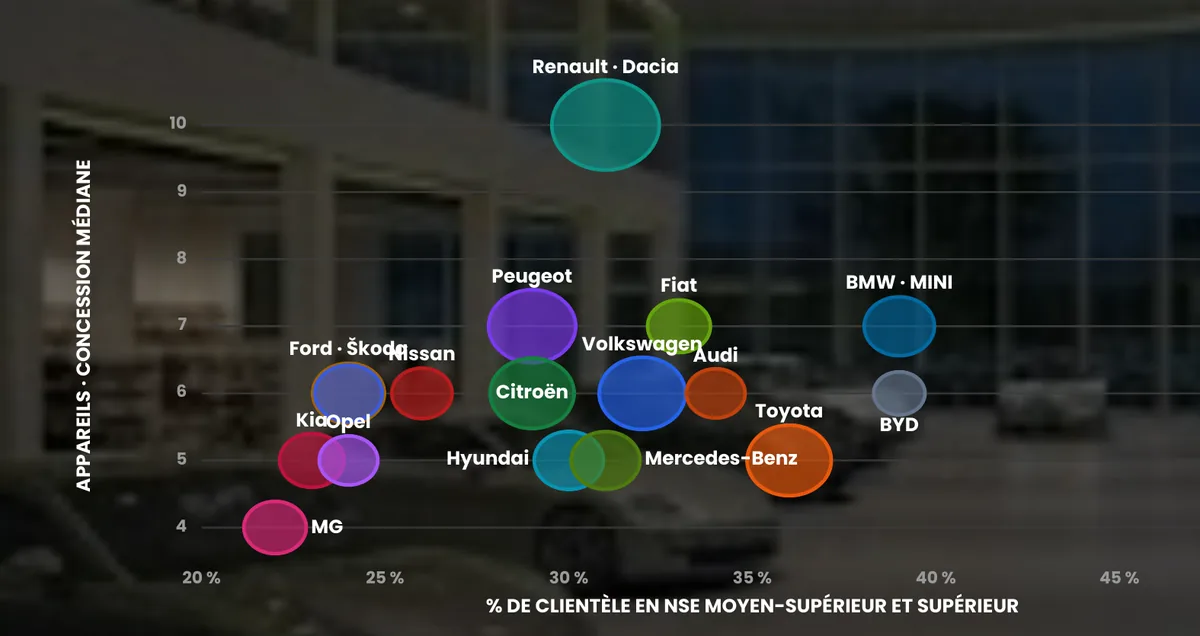
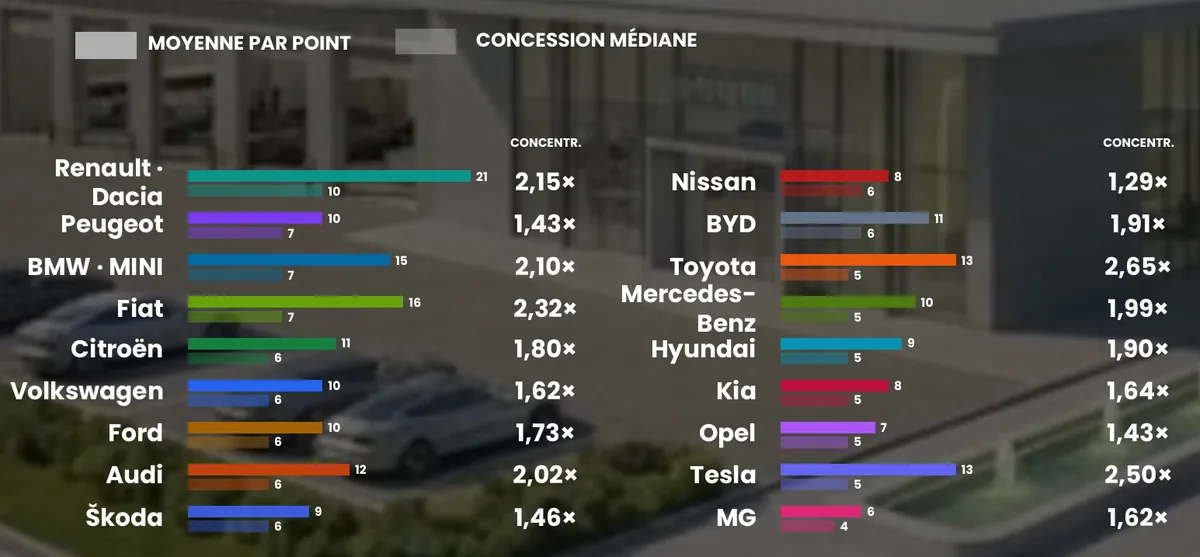
The median Renault · Dacia dealership receives 10 devices in the quarter, the highest traffic per point of sale; Peugeot, BMW · MINI and Fiat follow, with 7. At most brands the average sits well above the median: Toyota (13 devices on average, 5 at the median, concentration of 2.65×), Tesla (2.50×) and Fiat (2.32×) show the strongest concentration and their traffic depends on a few sites. At the other end, Nissan (1.29×), Peugeot and Opel (1.43×) and Škoda (1.46×) spread their visits more evenly. MG has the lowest traffic: 4 devices at its median dealership.

03

Who walks into each dealership, by socioeconomic level

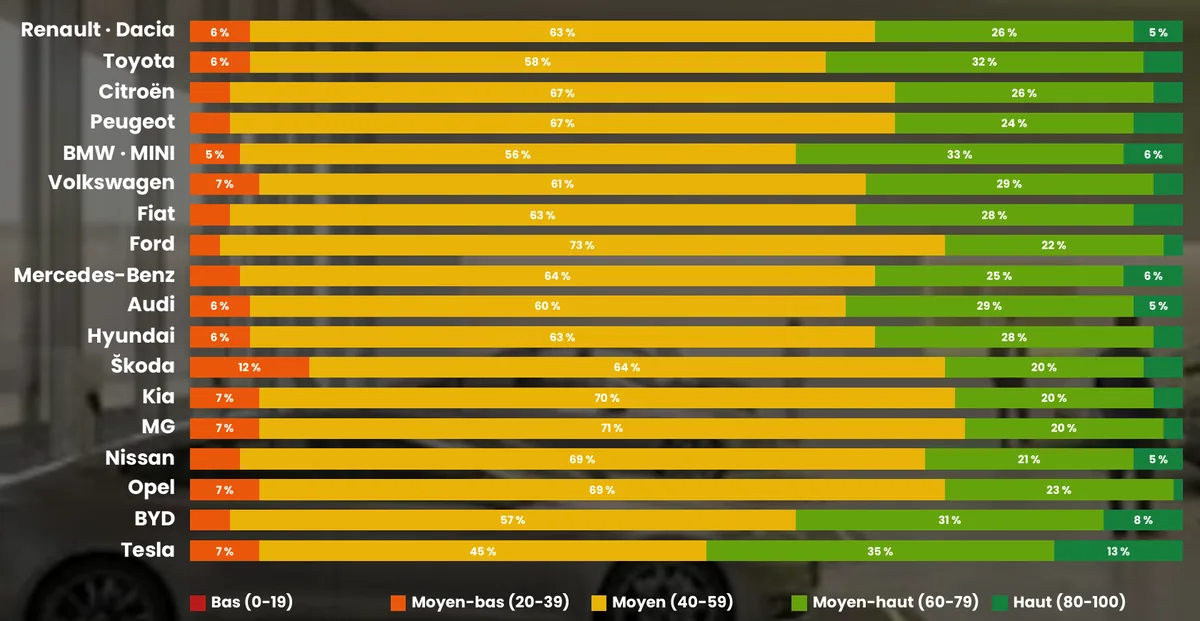
The profile is remarkably homogeneous: at almost every brand, most visitors live in middle-level areas. Tesla is the exception: the upper-middle and high levels (35 % and 13 %) outweigh the middle level (45 %). BYD (31 % upper-middle), BMW · MINI (33 %) and Toyota (32 %) also draw a slightly more affluent public. Ford (73 %), MG (71 %), Kia (70 %) and Opel (69 %) recruit mainly at the middle level; Škoda has the largest lower-middle share (12 %). The high-level bars are a floor, not a central estimate: the panel under-represents affluent customers.

04

Purchasing power against traffic

Renault · Dacia dominates on traffic, 10 devices at its median dealership, with customers of an intermediate level. Tesla sits at the opposite end: it is the brand most oriented towards affluent areas, but with modest traffic per dealership (5). BMW · MINI combines a more affluent public with solid traffic (7); BYD follows the same profile with lower traffic (6), and Toyota also draws a fairly affluent clientele despite more limited traffic (5). Finally, MG (4), Kia and Opel (5), Ford and Škoda (6) combine lower traffic and a less affluent public.

05

Which brands share their visitors

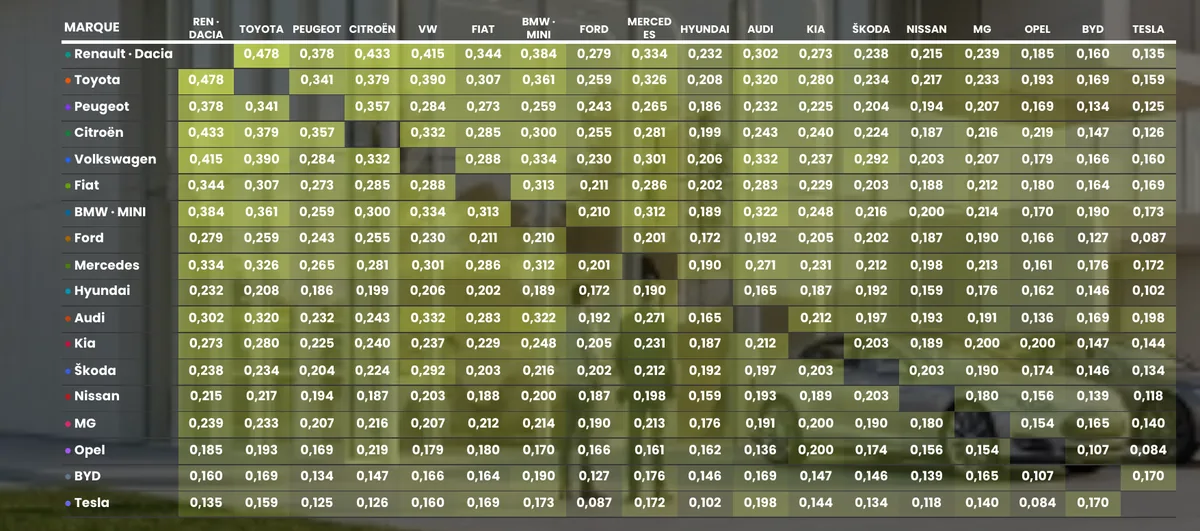
The generalists share their visitors widely: Renault · Dacia overlaps heavily with Toyota (Jaccard index of 0.478), Citroën (0.433) and Volkswagen (0.415), and its size makes it the market’s common crossing point. Among the premium brands, Audi, BMW · MINI and Mercedes-Benz form a coherent block (from 0.271 to 0.322 between them); Audi also sits close to Volkswagen (0.332) and Škoda follows the same group logic (0.292 with Volkswagen). Tesla mainly draws visitors from premium brands and from BYD: Audi (0.198), BMW · MINI (0.173), Mercedes-Benz (0.172), BYD (0.170). Opel, BYD and Tesla keep the most isolated audiences.

06

Where the visitors come from

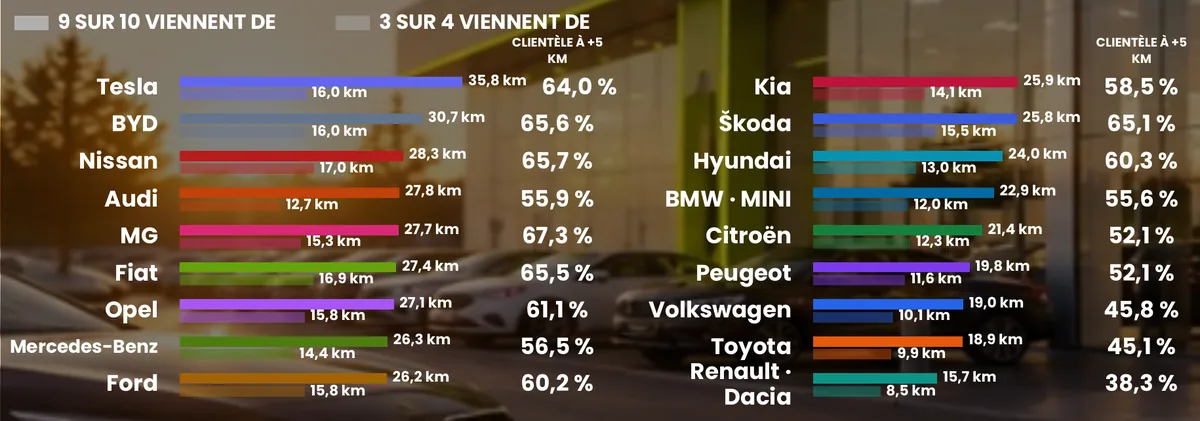
Tesla draws the visitors who come from furthest away: 9 in 10 live within 35.8 km, the widest catchment area. BYD (30.7 km), Nissan (28.3 km), Audi (27.8 km) and MG (27.7 km) also recruit across a wide territory: their sparser networks mean longer journeys. At the other end, Renault · Dacia has the most local customers (15.7 km), thanks to a very dense network; Toyota (18.9 km), Volkswagen (19.0 km) and Peugeot (19.8 km) share that proximity profile. At most brands, more than half of the visitors come from more than 5 km away: up to 67.3 % at MG, against 38.3 % at Renault · Dacia.

07

One leader almost everywhere, and a few regional strongholds

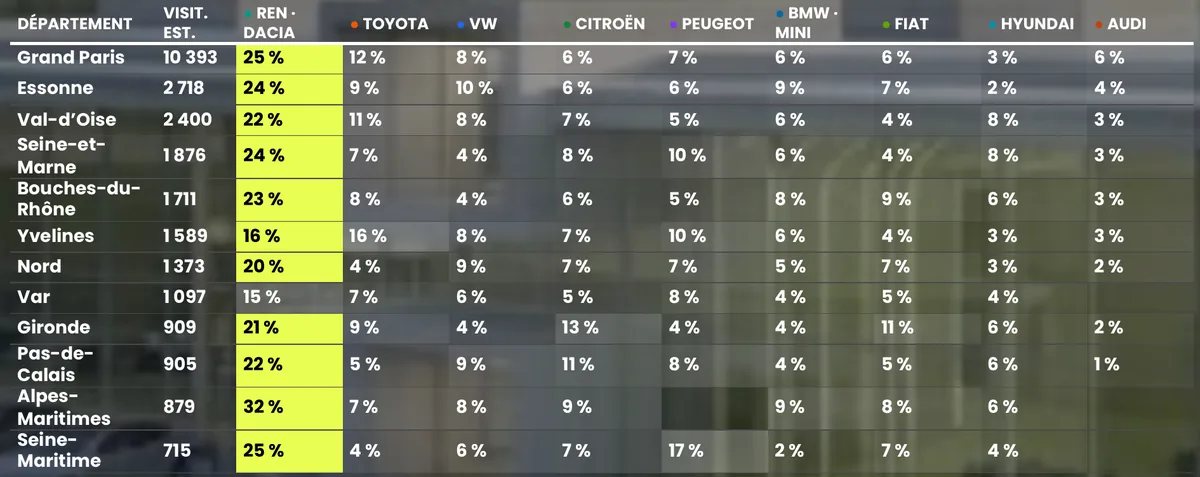
Renault · Dacia comes first in almost every département; its share peaks in the Alpes-Maritimes (32 %). In Île-de-France, Toyota, Volkswagen and BMW · MINI capture a larger share: in the Yvelines, Toyota is level with Renault · Dacia (16 % each). The other generalists hold few strongholds: Peugeot in Seine-Maritime (17 %), Citroën (13 %) and Fiat (11 %) in Gironde. Among the minority brands, Ford matches Renault · Dacia in the Var (15 %), Kia stands out in Pas-de-Calais (13 %) and Škoda in the Nord (8 %). Tesla and BYD gain ground in affluent départements such as the Yvelines and the Alpes-Maritimes, more than in central Paris.

Eighteen brands, one criterion: the visit that already happened

Read the report